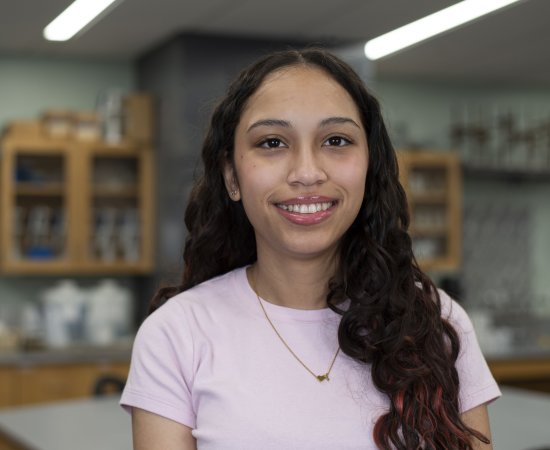
Biochemistry Major Yamilet Taveras ’27 awarded American Chemical Society scholarship
Yamilet Taveras ’27, a biochemistry major at Utica University, has recently received $10,000 in scholarship funds from the American Chemical...

Utica University Honors Students Published in Prestigious Haiku Journal
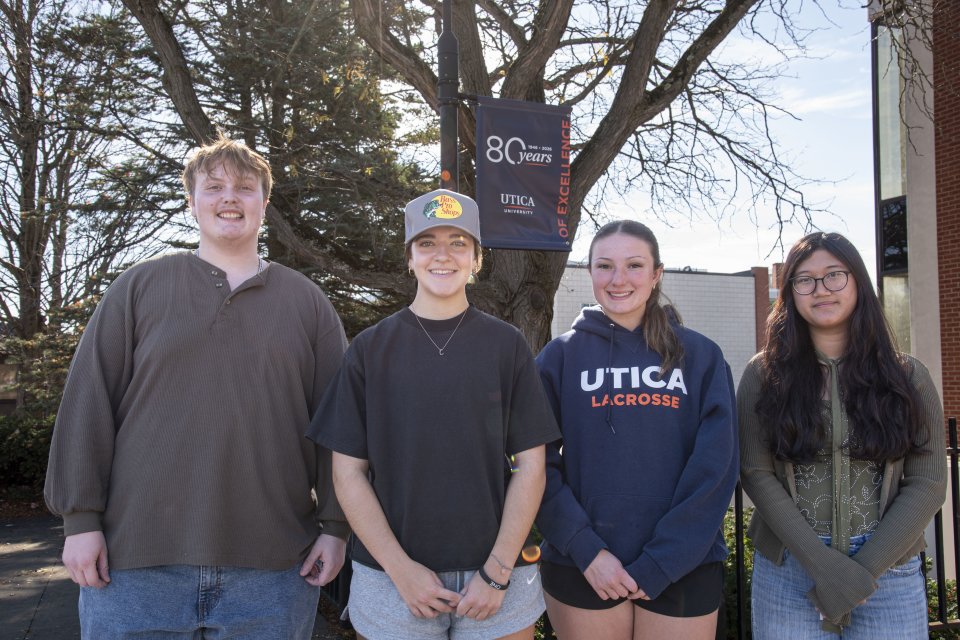
Four Utica University Honors Program students – Camryn Behonick ’29, Alex Papaleo ’29, Bu Paw ’28, and Alyssa Specchio ’29 – have earned publication in Frogpond, one of the most globally competitive haiku journals.
Published by the Haiku Society of America, the peer-reviewed journal accepts no more than 200 works from approximately 5,000 entries submitted each year. The students’ achievement places them among a select group of writers whose work has met the journal’s high standards, a distinction many poets pursue for years without success.
“Successfully publishing haiku demands understanding of genre conventions and modes of disjunctions that almost nobody outside of genre enthusiasts is familiar with,” says James Knippen, adjunct instructor of English.
“There are well-established haiku writers who are rejected (by Frogpond). That four students out of a 10-student seminar had work accepted, and two of our students had two poems accepted, that’s frankly amazing,” he continues. “You’ve got a 4 percent acceptance rate at a journal that writers from all over the world submitting to it, and they accept 200 poems per issue out of thousands and thousands that get submitted. That is, any way you look at it a statistical anomaly.”
All four students were enrolled last spring in Knippen’s HON 359 course, an upper-level interdisciplinary seminar that he teaches in part as a writing-for-publication seminar, guiding students through the process of preparing work for submission to a peer-reviewed journal of their choice. The course emphasizes not only writing and revision, but also understanding a journal’s expectations and tailoring submissions to meet its standards.
The experience begins with an unfamiliar art form. Many students have little or no exposure to haiku before entering the classroom.
“Haiku is actually a really challenging field, but it seems like it’s something that’s more accessible because it’s such a short form,” he says.
Knippen’s course challenges conventional assumptions about haiku, including the familiar idea that it must consist of three lines following a five-seven-five syllable pattern. By examining contemporary published work, students discover the range of approaches and techniques that define the form today.
From there, they learn to read like editors. Students closely analyze journals, identifying patterns in the work selected for publication and considering the aesthetic qualities and approaches that might appeal to an editor. They then apply those insights as they revise and prepare their own submissions.
The process offers lessons that extend well beyond creative writing. For instance, Knippen draws parallels between preparing a successful journal submission and applying for a job. Both require understanding an audience, researching expectations, presenting one’s strengths effectively, and tailoring an application to a specific opportunity.
“None of these students are going to go and be haiku writers for a career,” he says, “but I think something like this could open other avenues of thinking about what they might be capable of achieving if they put their mind to it.
“I think students take what they learn possibly in this haiku class and think about, ‘How can I use the fact that I was able to successfully get into this journal and use those same skills to effectively apply for and get this job?’”
Especially for undergraduates, the opportunity to publish in a competitive, peer-reviewed journal can change their sense of what is possible.
“I don’t think any undergraduate student, almost anywhere you would go, has that expectation coming into college,” Knippen says.
While the students may not pursue haiku professionally, he sees publication as a meaningful vote of confidence in their abilities and an opportunity to recognize what they can accomplish through focused effort, careful analysis, and revision.
Take, for example Behonick, a criminal justice major and member of Utica’s women’s hockey team. The experience reinforced a lesson she hopes to carry into her own career. After graduation, she hopes to pursue a career with the New York State Police or FBI, potentially after exploring opportunities to play professional hockey. She sees a parallel between those ambitions and the challenge of earning a place in a highly selective literary journal.
“They get so many submissions, and only a handful get picked,” says Behonick, who along with Specchio, had two poems published. “It’s the same way with the FBI, State Troopers, and professional hockey.
“In my life, what my parents have always told me is if you want something, you put your head down and you never say never. You just have to put in the work, set the statistical odds aside, and follow the process to making it happen. This definitely validates that.”
Knippen hopes the experience also challenges the assumption that publication is something undergraduates must wait years to pursue. Too often, he says, aspiring writers are told they are not ready to submit their work until graduate school, a mindset he views as a form of gatekeeping.
“I actually wish there were more professors who were thinking about these things, like encouraging undergraduates to write toward publication and demystifying it to some degree by showing students that it’s very possible,” he says. “They all have the potential to do it.”
He acknowledges the odds were long. But he encouraged them to try anyway, likening the students’ achievement to making a half-court shot in basketball.
“If you don’t take the shot, it’s absolutely never going to go in,” he says.
But Knippen insists the students’ achievement was about more than luck. Rather, it reflected the determination and know-how to pursue an achievement that once seemed out of reach.
“They know how hard it is to get in. Coming into the semester, none of them expects to get it, and that’s where we start. We start the class by saying statistically speaking, nobody is going to get published, but we’re doing to try,” he says.
“I guess I’m just proud of them more than anything. Because even though it can feel like a half-court shot, these students developed the skills necessary in order to do it. It wasn’t a crapshoot. They spent the whole semester practicing over and over again modes of disjunction, different kinds of form, monoku form. It was their hard work that got them in.”
For a general list of frequently used logins, you can also visit our logins page.